History of Świerzawa
The beginnings of Świerzawa remain a subject of speculation, but it certainly gained town privileges already at the end of the 13th century. It never had city walls. The town’s history was marked by natural disasters (floods, fires), plagues, and wartime destruction, including during the Hussite Wars in 1428. and the Thirty Years’ War. After World War II, Świerzawa lost its city rights, which it regained only in 1984.
Churches and sights of the town
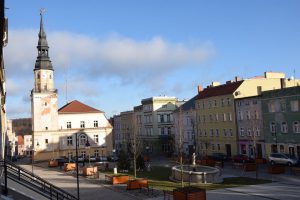
In the area of the historical centre, there are several interesting objects. The Church of the Assumption of the Blessed Virgin Mary, built at the turn of the 14th and 15th centuries, has retained many features of a Gothic building. Among the original construction elements are cross-ribbed vaults, tall pointed-arch windows, and richly decorated portals. The interior furnishings include an 18th-century main altar, a work by Michael Klahr the Younger, an outstanding Silesian sculptor from the Baroque period.
The former evangelical church in the Market Square is currently used as a Catholic church. Built in the mid-18th century, it was renovated into a Neo-Gothic style in 1876–78. One architectural complex with the evangelical church is the town hall from the early 19th century.
The church of St. John the Babtist and St. Catherine of Alexandria in Świerzawa is one of the most valuable landmarks of religious architecture in the region and is also one of the oldest examples of Romanesque architecture in Poland. It currently serves as a secular museum.
Geology
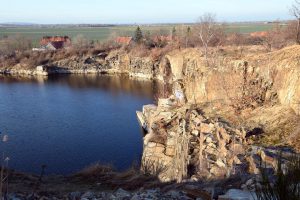
Along the road in the Kamiennik Valley, leading to the stone dam of a dry flood protection reservoir, there are interesting geological exposures of Permian-age rocks. These are alternating sandstones, conglomerates, and mudstones with a characteristic red hue. They are interpreted as the result of short-lived, rapid river floods, typical of a desert environment.
Description: Piotr Migoń