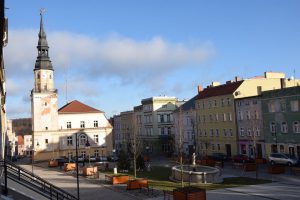
Snowidza is a large village in the northeastern part of the Jawor Plain, with a history dating back to at least the end of the 13th century. From the beginning of its existence, Snowidza has primarily been an agricultural community, utilizing the relatively fertile soils in the vicinity. With the spread of sugar beet cultivation in Lower Silesia, a sugar beet refinery was built in Snowidza in 1848. It was dismantled in the post-war period.
In the center of the village stands the Church of the Ascension of the Lord, originally built in the Gothic style at the turn of the 14th and 15th centuries, later rebuilt in the Baroque style in the 18th century, and surrounded by defensive walls. Notable interior elements include the painting of the Last Judgment, a stone baptismal font, and Renaissance tombstones. Only the Neo-Gothic tower from the late 19th century remains from the former Evangelical church located nearby. The former von Nostitz palace, now in a Neoclassical style, is currently not in use. The terraced garden layout that once existed around the palace has lost its spatial arrangement, and a bit further, there used to be a palace park. In the park, several monumental trees have survived: London plane and white poplar, estimated to be over 150 years old. To the north of the village, on the wooded slope of the Modzel valley along the road to Pawłowice Wielkie, there is a picturesque granite obelisk measuring 6 meters in height and a “Heroes’ Grove” commemorating the villagers who perished during World War I.
Description: Piotr Migoń