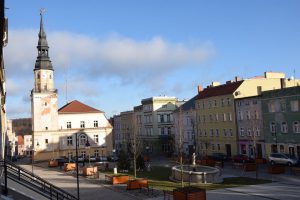
Słup in the western part of the Jawor Plain is an old village, mentioned under this name as early as 1202. The name probably comes from the observation and watchtower, whose location was favored by the terrain’s configuration. Together with the neighboring Winnica, it was the property of the Cistercians from Lubiąż and remained in their possession until the dissolution of the order in 1810.
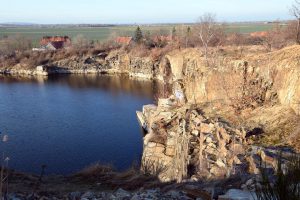
In 1974, work on the construction of the Słup water reservoir began (completed in 1978), and above the village, an earth-concrete dam with a length of 940 meters was built. To the south of the village, there stretches the basalt plateau of Kopista, which is a remnant of a volcanic lava cover. It is the largest form of this type in the Land of Extinct Volcanoes.
Above the village stands the Church of the Assumption of the Blessed Virgin Mary, mentioned as early as the 13th century but existing in its present form from the 15th century, extensively renovated in the Baroque style. Inside the chapel, there is a Baroque baptismal font, and on the vestibule wall, there is a Renaissance epitaph. The churchyard is enclosed by a wall with preserved gun ports, and within its confines, there are several other interesting objects. From the 16th century comes a burial chapel, and within the churchyard, there is also an ossuary – a place for storing human bones from dismantled graves. Next to the wall surrounding the church stands a stone pillar shrine and four stone reconciliation crosses. On them, there are engravings of crime weapons: swords and crossbows.
Description: Piotr Migoń