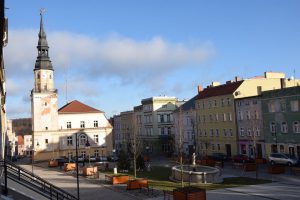
The prominent feature in the panorama of Pielgrzymka, a large village in the central part of the Kaczawskie Foothills, is the church of St. John Nepomucene, erected in the mid-13th century and thoroughly rebuilt in the 16th century. From 1524, it served the Evangelicals, and after the Thirty Years’ War, it functioned as a so-called escape church for the residents of the Duchy of Świdnica-Jawor. This necessitated the addition of three levels of galleries (one was later dismantled) adorned with murals. On the external and internal walls of the church, there are epitaphs dating from the 16th to the 19th century. In the churchyard, there stands a magnificent stone monument commemorating those who fell in World War I.
Not far from the church stood a palace, often occupied by commanders of military units fighting nearby as their headquarters. During the Thirty Years’ War in 1626, Albrecht von Wallenstein stayed there, Prussian commanders quartered here during the Seven Years’ War, including King Frederick II the Great, and during the Napoleonic Wars, King Frederick William III, Tsar Alexander I, and Field Marshal Gebhard von Blücher stayed here. After the village was occupied by the Red Army in 1945, the palace burned down, and its ruins were demolished in the 1970s . In the village, some old residential and residential-economic buildings deserve attention, including the farm complex on the border with Wojcieszyn. Some houses have a mixed masonry-timber frame construction with slate cladding.
Description: Piotr Migoń