Kondratów is a long chain village in the eastern part of the Kaczawskie Foothills, situated in the valley of the Wilcza River – a tributary of the Kaczawa. It existed already in the 13th century and was formally established in 1311. It was a knightly possession and for a long time, until the Thirty Years’ War, it belonged to the von Zedlitz family. During the Prussian era, the village prospered, and its residents were engaged in agriculture, forestry, and copper mining. After World War II, the village depopulated, a significant part of the buildings fell into ruin, and the former Evangelical church was dismantled.
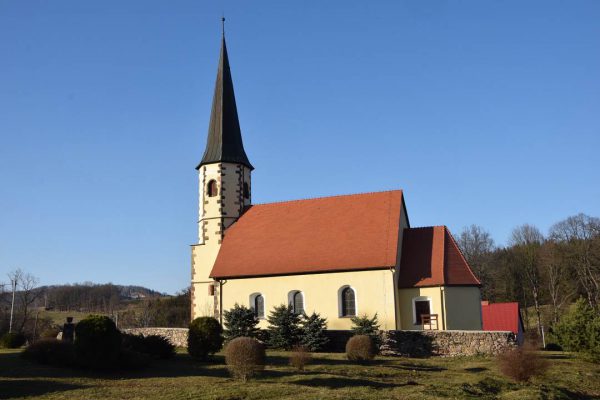
Among the historically significant structures is the church of St. George, built in the 13th century, rebuilt in the 16th century, and reconstructed in the second half of the 17th century. It has a rich interior, including 16th-century wall paintings, a Renaissance baptismal font and pulpit, Baroque altars, and stone tombstones, mainly from the von Zedlitz family. Opposite the church, on the northern slope of the valley, stood the von Zedlitz manor from the 16th century, now completely in ruins. Next to it, there are the remnants of a terraced garden and the remains of outbuildings accompanying the manor. Some residential and economic buildings have a traditional mixed masonry-timber frame construction. To the southwest of the village lies Kondratowski Lasek, characterized by grove features with oak, lime, maple, hornbeam, and ash, along with a rich undergrowth, including many protected species. The slopes also feature low outcrops of greenstone rocks.
Description: Piotr Migoń