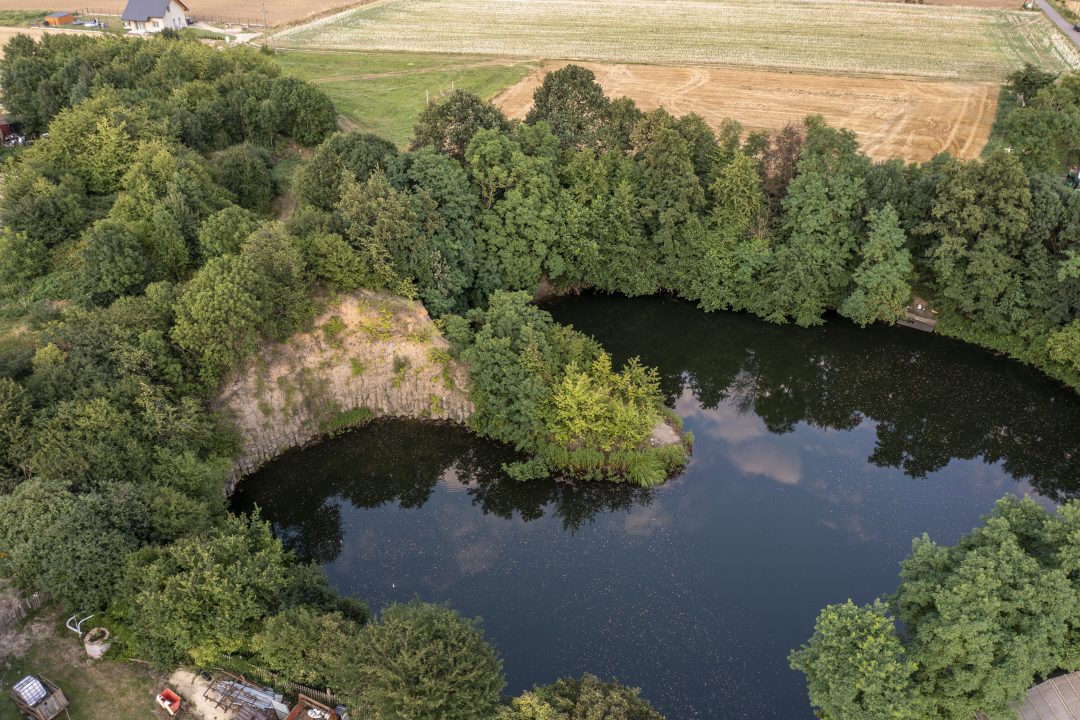
The basalt quarry is located on the eastern outskirts of the buildings in the village of Pawłowice Wielkie, approximately 160 metres from the main road in the village. The basin of the basalt quarry, with an oval shape, has an area of nearly 0.5 hectares. “Due to the flooding of the quarry bottom, the height of the walls is difficult to assess, but it likely reaches approximately 15 to 25 metres.
In the basalt quarry, basalt rocks are exposed, and their isotopic age has been determined to be nearly 21 million years, indicating a younger, early Miocene stage of volcanic activity. This contrasts with the older age, 10 million years earlier, of the basalt stream in Mikołajowice, located just under 1.5 km to the north. This indicates that volcanism influenced the discussed region during different periods of the Cenozoic era. The basalts from Pawłowice are rocks of black colour, resulting from their mineral composition. In most cases, they exhibit an aphanitic texture (without visible crystals), although locally they also show a porphyritic texture, where larger crystals of pyroxenes and green olivines are visible in the black so-called groundmass. The basalts occur in the form of well-developed columns, which are the result of thermal shock during the lava cooling stage. The columns, in cross-section, take the form of polygons (usually hexagons or pentagons), but they do not exhibit perfect regularity. This means they do not have uniform thickness along the entire length of the column; instead, they are thickened in some places and narrowed in others. The thermal joint occurs in accordance with the principle that the longer axes of the forming columns are perpendicular to the cooling surface. The vertical columns indicate that the observed basalts are a solidified lava flow that was cooled from above (from the surface). The somewhat irregular structure of the columns, in turn, suggests that this is already the marginal zone of the stream, close to the contact with older rocks. The basalts are subjected to weathering processes, and the effects of these processes are visible in the walls. The degree of weathering of basalt rocks is significantly higher in the near-surface parts and decreases towards the interior.
The site is interesting from an educational perspective as it provides an opportunity to learn about the effects (i.e., basalt rocks) of one of the most spectacular geological processes, which is volcanism.